
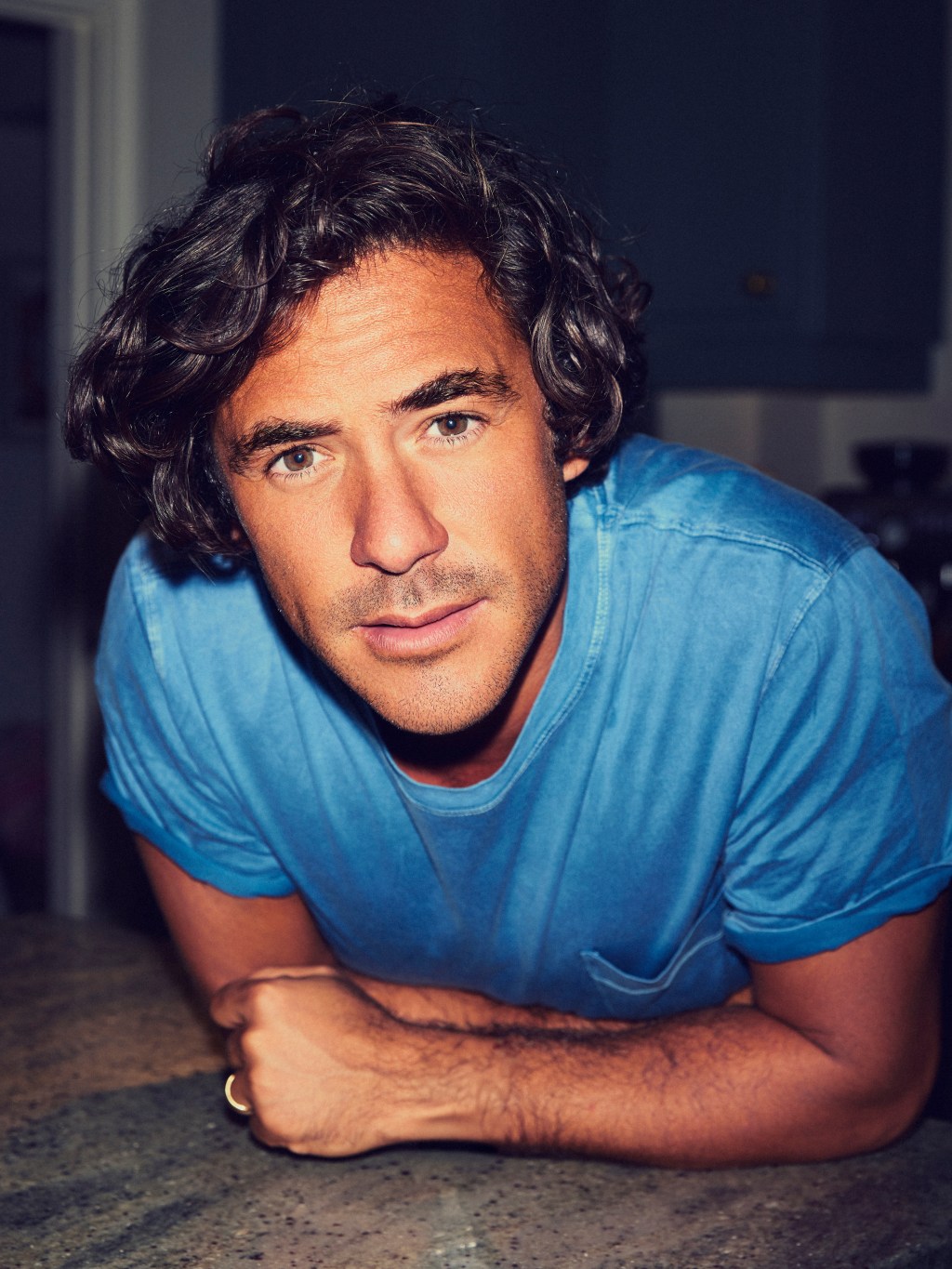
Jack Savoretti’s twenty-year career rather thoroughly rewrites the career model we have become accustomed to in the British music industry. The British singer-songwriter, who has Italian, German and Polish roots, has so far placed five albums in the UK Top 10 – with both Singing to Strangers and Europiana reaching No. 1 – while his best ever result in the singles chart remains the rather modest No. 70 achieved by Candlelight. The same peculiar dynamic is visible in his latest releases: We Will Always Be The Way We Were, released in April 2026, reached No. 2 on the overall UK Albums Chart while topping the physical sales, download, independent and record shop charts. After two decades, this has long ceased to look like a statistical curiosity or an isolated occurrence; it is much more convincing evidence of an alternative way of building a career that has proved remarkably consistent.
In light of all this, Savoretti can hardly be described as a forgotten cult artist known only to a narrow audience. Born in London into a British-Italian family and raised in Switzerland, the singer-songwriter began his career in the mid-2000s; since his 2007 debut, Between the Minds, he has released nine studio albums. Over the years, he has travelled from the stripped-back acoustic singer-songwriter world of his early work to sweeping string arrangements, through the soul, funk and disco-inflected Europiana, and on to Miss Italia, recorded entirely in Italian. It is an eclectic artistic path that sits rather awkwardly within the conventional framework of a success story, because Savoretti’s career contains far more contradictions than that.
Although he has a substantial and loyal following in Britain – his Royal Albert Hall concert celebrating twenty years of his career, for instance, sold out in less than an hour – he still does not have the kind of ubiquitous radio mega-hit that would make him instantly recognisable even to someone who has never deliberately looked up his name. This uneven presence becomes particularly visible on the map of his European tours. This year, Germany gets only Berlin and Hamburg, both at theatre-sized venues – and in the latter city, where I live, I still regularly come across otherwise musically knowledgeable people whose faces remain completely blank when I mention his name – while in Budapest he is returning four years after a sold-out show at Akvárium Klub for an event on a considerably larger scale.
I found Jack Savoretti’s music entirely by accident in 2021, while browsing YouTube for music one evening. The algorithm served me a live version of Breaking the Rules, which took me completely by surprise because, judging from the opening shots, I had expected some sad, melancholic love song. Instead, pretty much the opposite happened. Savoretti himself is not even visible at the beginning of the black-and-white video: we first see only the venue, a few details of the preparations and a hand playing the piano, while that drawn-out, charismatic, raspy voice has already begun. When he finally appeared, I was surprised that the voice belonged to a man in his thirties; from the sound alone, I had imagined someone considerably older and more robust. I can still remember getting goosebumps, because this is precisely the kind of voice I tend to love and actively look for in singers. I like musicians with a recognisable personality, who are willing to make bold choices and, if the song calls for it, present it in a completely different way from the studio recording.
At the time, I was working at Müpa Budapest, one of the city’s largest cultural institutions, as an editor in its Studio department. I interviewed musicians and other artists appearing at the venue and worked on concert films, so following music and different musical directions was already part of my job. Nor had I entirely abandoned music journalism: I was still publishing regularly whenever time allowed, which meant that looking for new artists was not merely a pointless way of satisfying my evening curiosity. I tried to keep track of what was happening internationally, which new artists were emerging, how individual genres were changing, and whose work deserved a closer look.
With Savoretti, as should already be clear, it was his voice that caught my attention first, and only afterwards did I begin looking more closely at his body of work: where he had started and where the previous two decades had taken him. The more familiar I became with his music, however, the clearer it became that a distinctive singing voice alone could hardly sustain a twenty-year career, nor could it explain the deeper layers of the work behind it.
Early in his career, Savoretti was much closer to the territory that could comfortably accommodate the singer-songwriter label. His 2007 debut, Between the Minds, was built largely on acoustic foundations, with voice and guitar remaining central throughout. By the time of Before the Storm, he was consciously moving towards a band sound: the songs were recorded with four or five musicians playing together, capturing complete takes in the studio. Then, while making Written in Scars, he changed the songwriting method itself. Previously, he had generally started with lyrics and melody, adding rhythm later; after watching a documentary about Paul Simon, he reversed the order. They began by finding the rhythmic foundation and built the songs on top of it – Savoretti himself described groove, drums and bass as defining elements of the album.
When he spoke to MusicRadar in 2016 about the albums that had shaped him, the thinking behind this change became easier to see. What he admired about Paul Simon’s Graceland was the way its songs could be very different from one another and still belong together; Half Moon Run’s Dark Eyes, meanwhile, reinforced his belief that a song written on an acoustic guitar did not necessarily have to become an acoustic recording, and that there was no reason to settle for the first rhythm that presented itself. Across those three albums, then, the change was not simply a matter of how many instruments were playing behind Savoretti: increasingly, he stopped treating the form in which a song was born as something fixed.
Catapult reveals another side of this. On the studio recording, Savoretti holds back for long stretches from the raw, raspy delivery that is one of his most instantly recognisable characteristics as a singer, allowing it to come properly to the foreground only at certain moments. Live, however, he does not rigidly reproduce the delivery heard on the record: across different concert recordings, the same passages can be sung more gently on one occasion and with considerably more force on another. With a voice this distinctive, that matters particularly because the rasp could very easily become mannered if he used it in exactly the same way in every song and every situation.
By the time Europiana arrived, I knew Savoretti’s earlier work well enough for it to be the first new album of his that I did not discover retrospectively. I ordered it and listened through it several times, initially simply as someone who enjoys music and later with a much more critical ear, paying attention to how the songs were constructed and which musical influences were being placed alongside one another. Savoretti derived the album’s concept from the way American soul, funk and disco reached Europe in the 1970s and ’80s and encountered the songwriting traditions already here. He associated the latter primarily with melody, melancholy and storytelling; from the meeting of the two came what he called Europiana. He summed up his aim in a remarkably precise phrase:
“To perpetuate, not imitate”.
— Jack Savoretti on the idea behind Europiana, Billboard Italia, 2021
On the album, what I particularly like about Calling Me Back to You is its stubborn, circular pulse, which drives almost the entire track forward while Savoretti’s vocal is considerably more melancholic. The pulse barely changes, yet never becomes static; it is precisely the constant repetition that carries the song along. Dancing Through the Rain – currently one of my favourite Savoretti songs – also relies heavily on repetition, but I never feel that it is simply treading water. The bridges interrupt that circular motion, so when the familiar sections return afterwards, they no longer feel quite the same as they did before.
The BBC Concert Orchestra version of Greatest Mistake places Savoretti’s voice in a completely different environment. The orchestral arrangement makes no attempt to disguise the difference between the roughness of his vocal and the more ordered sound of the strings, and fortunately it does not simply use the larger forces to make the song even more monumental. Savoretti’s raspy voice remains clearly distinct from the orchestra throughout, and it is precisely this contrast that makes the recording interesting.
Savoretti does not always get this balance right. By the time of Sleep No More, he already had almost everything at his disposal from which a “big” Savoretti song could be constructed: raspy vocals, a major emotional theme, a broad chorus, atmospheric production and strings whenever required. For me, Only You shows the less successful side of that formula. At the beginning, there is still a fair amount of space around Savoretti’s voice, but more and more layers are added as the song progresses. The strings, backing vocals and reverb mostly emphasise what the vocal has already communicated perfectly well on its own: whenever the melody becomes more emotionally intense, the arrangement intensifies along with it. None of these choices bothers me individually, but together they leave too little room for the song occasionally just to exist. Savoretti’s voice can carry the emotional weight perfectly well by itself; here, I sometimes feel that the production does not trust it enough.
The same album contains Touchy Situation, a song that stopped me in my tracks the first time I heard it. At that point, I knew nothing about how it had come about. For long stretches, it sounded more like a monologue to me than a conventional pop song: the words keep moving forward and the music follows them, until suddenly a much stronger, more dramatic section arrives, which initially felt almost as though we had briefly wandered into another song. Afterwards, we return to where we started. I could not quite decide what it was that bothered me about it, only that it bothered me in a good way, so I listened again several times.
I found the explanation later. Through Bob Dylan’s team, Savoretti was given a previously unused Dylan lyric. He first tried writing music for it on guitar, but after a few hours concluded that whatever he did would turn into a Dylan imitation. He put down the guitar, moved to the piano and started again from there. In the same interview, he spoke about how Dylan often works not with conventional choruses but with statements, while Savoretti’s own songwriting instinct prefers a constructed arc and a destination for the song to reach.
Both survived into the finished recording. He did not try to force the long stretches of text into regular verses and choruses, while the more dramatic section between them is much closer to the way Savoretti himself tends to construct a song. What I had initially experienced simply as something strange therefore made much more sense afterwards: within the same track, you can hear the more irregular movement of Dylan’s words alongside Savoretti’s need for the song to have somewhere to go. And the two writers did not even have to meet.
The next real challenge was one Savoretti set himself. The death of his father and the changing nature of his relationship with his Italian roots both played an important part in the making of Miss Italia, but as a songwriter he encountered a much more prosaic difficulty: speaking Italian all his life did not automatically mean that he knew how to write songs in Italian.
He told Corriere della Sera that it took him roughly a year to learn. In English, he came from the songwriting tradition he knew through Paul Simon, Bob Dylan and Leonard Cohen, in which, as he saw it, even stripping everyday speech down to its essentials could sound poetic. Italian did not work in quite the same way. He had to deal with a different metre and a different poetic language while also learning how to avoid what he described as the “sole, cuore, amore” trap. He began learning from Italian songwriters and later described this period as a return to learning after years of writing songs professionally.
“I became a student again.”
— Jack Savoretti on writing Miss Italia and how the experience shaped his next album, Music Week, 2026
And after twenty years of songwriting, that must have been a rather unusual position to find himself in. By then, countless decisions had become instinctive: what kind of sentence works as a lyric, what fits into a line, what sounds natural coming out of his own mouth. In Italian, he could no longer rely on those instincts in quite the same way. He did not have to relearn songwriting itself; he had to learn how everything he had previously done instinctively worked in another language.
Ultime Parole, with Natalie Imbruglia, already shows what Savoretti began doing with Italian once he had gone through that learning process. The song does not keep its two languages separate: Italian and English lines sit alongside one another, while the chorus returns in both languages. Imbruglia is not simply a guest vocalist here, either, but a co-writer; the song is credited to her, Savoretti, Samuel Dixon and Simone Zampieri. Behind the collaboration, moreover, are their very different relationships with their Italian heritage. By Savoretti’s own account, he has always experienced his Italian connection with pride, whereas assimilation played a much stronger role in the story of Imbruglia’s family as she grew up in Australia. For me, this means the alternation between the two languages no longer functions simply as a formal device: the same loss is being sung by two people for whom Italian identity has meant very different things. Savoretti himself later cited Ultime Parole as an example of how making Miss Italia had given him more tools with which to use the Italian language.
Luigi Tenco’s Vedrai, vedrai, however, entered Savoretti’s repertoire much earlier. The version recorded at his Venice concert already appeared on the 2019 edition of Singing to Strangers, and around the same period Savoretti was still saying that although he enjoyed singing in Italian, he did not feel sufficiently equipped to write lyrics in the language. In retrospect, the Tenco cover therefore feels almost like a prehistory of what would happen five years later on Miss Italia: the Italian song was already part of his repertoire, but his own Italian songwriting voice was not. His choice was personal as well. He later recalled that Vedrai, vedrai had meant a great deal to him in his twenties, when he first became a father and the future felt more frightening than predictable. The promise at the heart of the song is not one of certain triumph either: its pain lies precisely in the speaker saying that one day everything will change while having no idea when or how. To my ears, that uncertainty suits Savoretti’s voice far better than an immaculately constructed romantic resolution.
The experience of making Miss Italia also influenced the working method of the album that followed. When Savoretti spoke about We Will Always Be The Way We Were in 2026, he explicitly connected the two processes. With Singing to Strangers, Europiana and Miss Italia, he had begun work with a fairly precise idea of the world he wanted to build; this time, he did not want to decide in advance what kind of album it should become. He returned to old bandmates and to the West London places where he had worked early in his career, then allowed the songs to reveal their direction through playing together. Savoretti aptly described the result as a “jeans-and-T-shirt album”.
On Tempting Fate, alongside KT Tunstall, my first association was John Mayer. Not because of any specific melodic resemblance; the connection lies more in the guitar’s easy groove, Savoretti’s less dramatic vocal delivery and that slightly self-deprecating male narrator who knows perfectly well that he is probably heading towards a bad idea, without that knowledge making the bad idea any less appealing. After the larger, carefully constructed productions, it suits Savoretti to have a band here that does not try to turn every moment into an event.
I Hear You Calling reflects even more directly what Savoretti learnt about writing in Italian while making Miss Italia. The album contains an entirely English version, but not long afterwards came I Hear You Calling (Echi Di Sirene) with Italian artist MILLE. This is not simply an Italian translation of the original song. Savoretti’s English sections remain, while MILLE enters between them with her own Italian lyrics, and the two languages then begin alternating within the same song. The Italian section also adds a far more unsettled relationship to the encouraging, almost reassuring tone of the original: arguments, an empty flat, a radio falling silent, and the point at which even a phone call – or the absence of one – begins to mean something. We are therefore not hearing the same thing twice in two different languages; the Italian lyrics write another perspective into an already existing English song.
What had still been a separate learning process during the making of Miss Italia appears much more naturally here. And Echi Di Sirene was not a reworking made years later: the original I Hear You Calling was released on 11 March 2026, followed by the Italian-English version on 26 March. Barely two weeks separated them.
There is, however, another story running through Savoretti’s past twenty years, one less immediately visible than the music itself: the way his audience has grown. Written in Scars had already reached No. 7 on the UK Albums Chart in 2015 and spent a total of 41 weeks on the chart; with the albums that followed, Savoretti climbed progressively higher, eventually reaching those two No. 1 records. His singles, meanwhile, have followed an almost entirely separate trajectory: he still has no UK Top 40 single.
“I’ve never had that one song that does the heavy lifting, it’s always been the album that’s kept us alive.”
— Jack Savoretti on building his career around albums, Official Charts, 2026
In 2026, that contrast is even more striking than it was ten years ago. Streaming, social media and short-form video platforms have fundamentally changed how a listener might first encounter a new artist and how quickly a single song can reach an enormous audience. Alex Warren provides a useful counterexample because his career was built in almost the reverse order. He already had a substantial audience on YouTube and TikTok before his music career truly took off; then, in 2025, Ordinary spent thirteen weeks at the top of the UK Singles Chart and became one of the defining hits of the year. The enormous online attention came first, followed by a song that reached far beyond the audience that already knew Warren.
Savoretti started twenty years earlier, and there is no comparable moment in his career when a single song suddenly dragged everything else along with it. What emerges instead is a picture of albums, tours and an audience that grew gradually and then kept returning. Neither route is better or more authentic than the other, and perhaps there is little point in comparing them in those terms. What is much more interesting is that both eventually lead to the same, more difficult question: how does a moment of attention become an audience that is still there for the next album and the next tour?
In Savoretti’s case, the VIP Upgrade offered for the 2026 tour provides a particularly tangible example. In addition to an existing concert ticket, a limited number of £100/€100 packages are being offered, including a meet and greet, a photo together and signing opportunity, early entry, a welcome drink, dedicated merchandise access, a laminated pass, a signed limited-edition tour poster and a tote bag. Newsletter subscribers were also given access an hour before the general sale.
You can call this direct-to-fan or superfan strategy, but the mechanism is simpler than the jargon makes it sound: if someone has been buying your records and going to your concerts for ten years, you do not have to find them all over again through an algorithm every time. You can write to them directly, give them earlier access, offer them a chance to meet you or something signed. And perhaps more importantly, you are not starting from the same place with them as you are with someone who heard fifteen seconds of one of your songs for the first time last night.
In London, the Royal Albert Hall fills in less than an hour; Budapest has already had a sold-out Akvárium show; Italy has been a story of its own since Miss Italia, while Germany gets just two standalone dates on this year’s UK and European tour. My cheaply conducted Hamburg opinion poll still consists of occasionally dropping Jack Savoretti’s name into conversation and seeing how many blank looks I get in return. I am obviously not going to draw any serious market conclusions from that. It is, however, a useful reminder that even within Europe, the phrase “well-known artist” can mean remarkably different things depending on where exactly you happen to be standing.
Not long after I discovered Breaking the Rules in 2021, I also happened to speak to Savoretti completely by chance during an Instagram Live. I showed him a portrait of him that I had drawn shortly before and told him that, at the time, his music had managed both to calm me down and inspire me to create. He liked the drawing, we spoke for a few minutes, and then the live stream moved on.
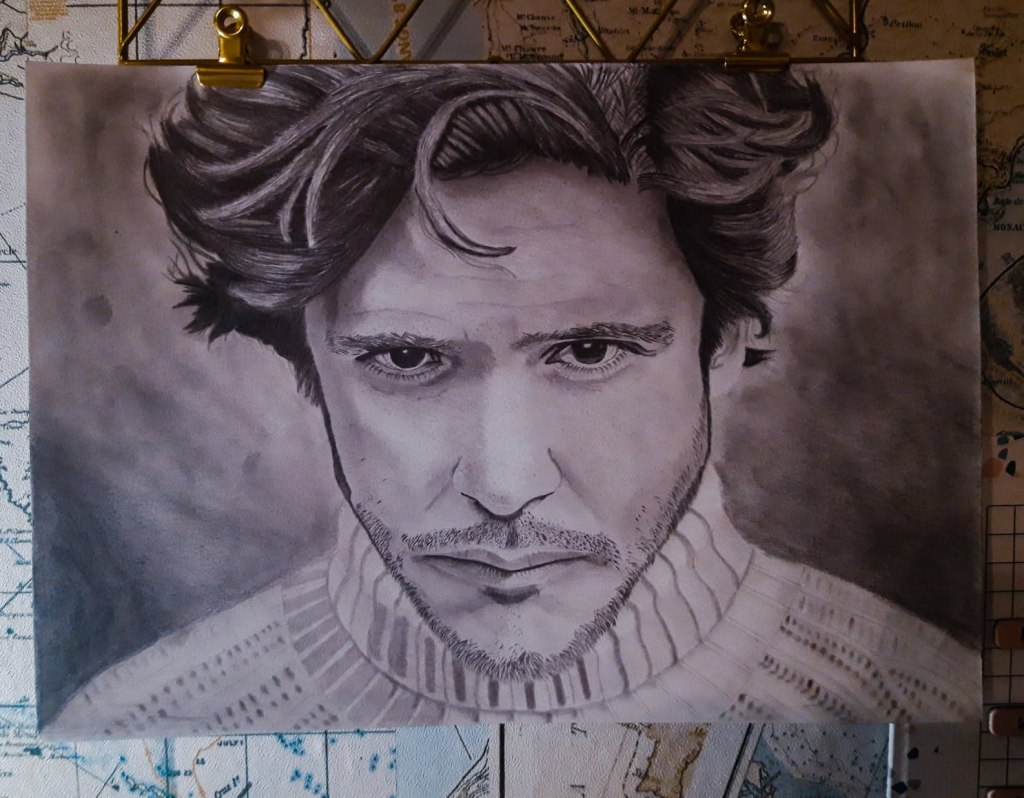
Drawing and photo: by me
Five years have passed since then. I moved from Budapest to Hamburg, while Savoretti made Miss Italia and We Will Always Be The Way We Were. Two years ago, I discovered that he was playing at the Laeiszhalle just three days before his Hamburg concert, by which point there was not much room left for manoeuvre as a journalist – it is relatively difficult to do serious preparatory work for a concert when the first step is discovering that it exists three days beforehand.
At least there is no danger of that happening this year. Savoretti returns to Hamburg on 8 October, this time to FABRIK, for one of only two German dates on the We Will Always Be The Way We Were tour. Details of the Hamburg concert and tickets are available on the FABRIK website.
Savoretti’s raspy voice made him instantly recognisable from the beginning, and it remains one of his most frequently mentioned characteristics. But after twenty years and nine studio albums, considerably more than that is keeping his career alive. He has never been content simply to write the same successful Savoretti song over and over again. His voice may have become his trademark, but his music has continued to reinvent itself, and Savoretti has never hidden the moments when doing so required him to relearn something he had previously taken for granted.
Sources & further reading
Main image: Chris Floyd, courtesy of Wizard Live.
- Official Charts — Jack Savoretti’s full UK chart history, including album and singles positions. Jack Savoretti – Official Charts history
- Official Charts — Jack Savoretti: “We Will Always Be The Way We Were is about self-acceptance” (2026). Interview on his album-led career, the making of We Will Always Be The Way We Were and his approach to albums as complete works. Read the Official Charts interview
- Music Week — Charlotte Krol, Incoming: Jack Savoretti talks new LP We Will Always Be The Way We Were (21 April 2026). On Miss Italia, learning to write in Italian and how that experience led into the creative process of the following album. Read the Music Week interview
- Billboard Italia — Federico Durante, Jack Savoretti: “Europiana è un mondo dove si festeggia ogni giorno” (17 June 2021). Interview on the musical idea behind Europiana and Savoretti’s concept of “perpetuate, not imitate”. Read the Billboard Italia interview
- Corriere della Sera — Andrea Laffranchi, Jack Savoretti: “Canto in italiano per ricordare papà, orgoglioso delle mie origini” (28 May 2024). On his father, Miss Italia and the year-long process of learning to write songs in Italian. Read the Corriere della Sera interview
- MusicRadar — Matt Frost, Jack Savoretti: the 10 records that changed my life (9 December 2016). Savoretti discusses the influence of Paul Simon’s Graceland, Half Moon Run’s Dark Eyes and the importance of rhythm, production and variation in his own records. Read the MusicRadar interview
- UK Music Reviews — Interview: Jack Savoretti. On receiving unused Bob Dylan lyrics and finding the musical approach that became Touchy Situation. Read the UK Music Reviews interview
Wizard Live — Official German press materials for Jack Savoretti’s We Will Always Be The Way We Were Tour 2026, including tour and album information and the Hamburg concert at FABRIK on 8 October 2026.


Leave a comment